Loading…
All models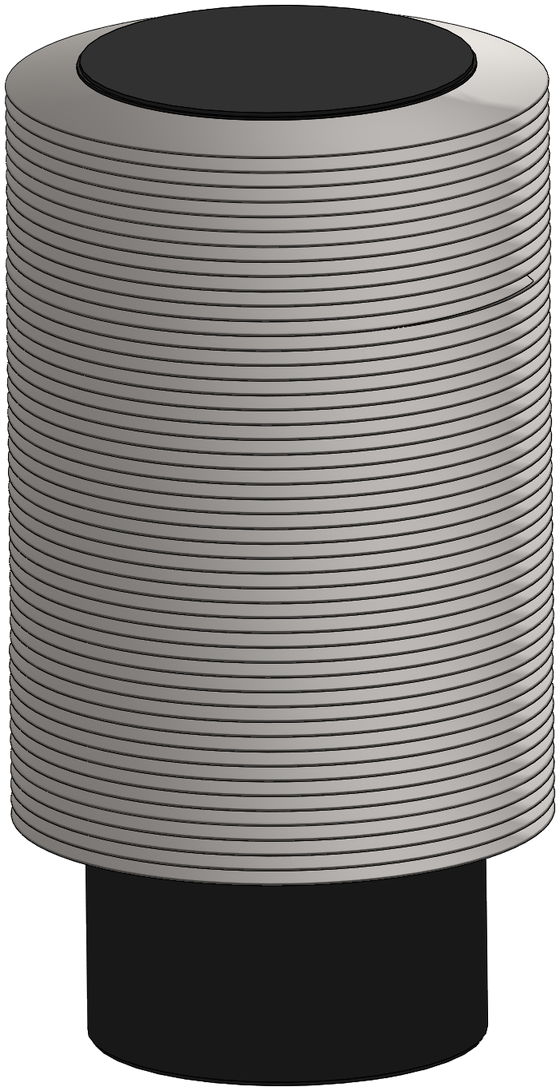
Product family · Primary
DAWT 250W
250WNameplate power
ModeledPrimary
Coevo's primary remote-power configuration and the centre of the product family. Designed for continuous remote generation where solar alone may not provide sufficient reliability or operating hours.
Engineering concept model · shown at relative scale
Preliminary specification
| Nameplate power | 250 W |
|---|---|
| Designation | DAWT 250W |
| Modeled generation @ 10 mph avg wind | 480 Wh/day |
| Equivalent average continuous | 20 W |
| Modeled output @ 20 mph | 128 W |
| Rated condition | 25 mph · 11.176 m/s |
| Cut-in wind speed | 3.5 mph · 1.56 m/s |
| Family position | Primary |
| Application class | Remote infrastructure and multi-load field compounds |
| Battery compatibility | Optional — AGM, LiFePO₄, gel, or an existing bank |
| Mounting options | Available during pilot configuration |
| Environmental configuration | Configuration dependent |
Preliminary engineering configuration. Nameplate ratings and modeled generation are the current approved marketing basis and remain subject to validation through wind-tunnel and field testing. Physical dimensions, weights, generator specifications, high-wind behaviour, and certification status are not final and are not published.
Modeled power estimate
Modeled performance — DAWT 250W
Modeled performancePower output in watts across wind speed. Hover the chart to read any point.
Approved performance points — DAWT 250W
Energy · Wh/day
480 Wh/day
At a 10 mph average wind, over 24 hours — 20 W equivalent average.
Power · W
128 W
Output at 20 mph wind speed.
Power · W
250 W
Nameplate, at the 25 mph rated condition.
Watts (W) are power at a moment. Watt-hours per day (Wh/day) are energy accumulated over 24 hours. A DAWT 250W is a 250 W nameplate machine that is modeled to generate 480 Wh over a day at a 10 mph average wind — the two numbers describe different things.
Modeled performance, not measured results. Output is modeled from the approved anchor points — nameplate at a 25 mph rated condition, with power following the cube of wind speed below it, so doubling the wind is roughly eight times the power. Figures are engineering estimates pending wind-tunnel and field validation, and are not independently certified.
At a 10 mph average wind condition, the DAWT 250W is modeled to generate 480 Wh over 24 hours — about 20 W of equivalent average continuous generation. At 20 mph the modeled instantaneous output is 128 W, reaching its 250 W nameplate at the 25 mph rated condition. Modeled performance, pending validation testing.
Complete system
The DAWT 250W Kit.
Most sites buy the turbine as part of a complete remote power kit — generation, power management, storage, and protected output specified together rather than assembled on site.
DAWT 250W Remote Power Kit · engineering concept
- 480 Wh/day
- Modeled generation at 10 mph average wind
- 11–14 W
- Continuous load budget
- 12 or 24 V DC
- System voltage
- 150–200 W
- Optional solar
Battery options
Storage is a choice, not a fixed part of the kit. Charge profiles and disconnect thresholds are set for whichever chemistry the site wants.
LiFePO₄AGMGelExisting bank
What ships with it
- Generation
- Control and conversion
- Storage
- Mounting and structure
- Commissioning and monitoring